Tuning and benchmarking Apache and MySQL
Have you ever found yourself needing to speed up apache or mysql? Here's a quick writeup on some very useful tools when you first setup Apache and MySQL.
Have you ever found yourself needing to speed up apache or mysql? Here's a quick writeup on some very useful tools when you first setup Apache and MySQL. These will help you optimize and build out the absolute best configuration for your webserver.
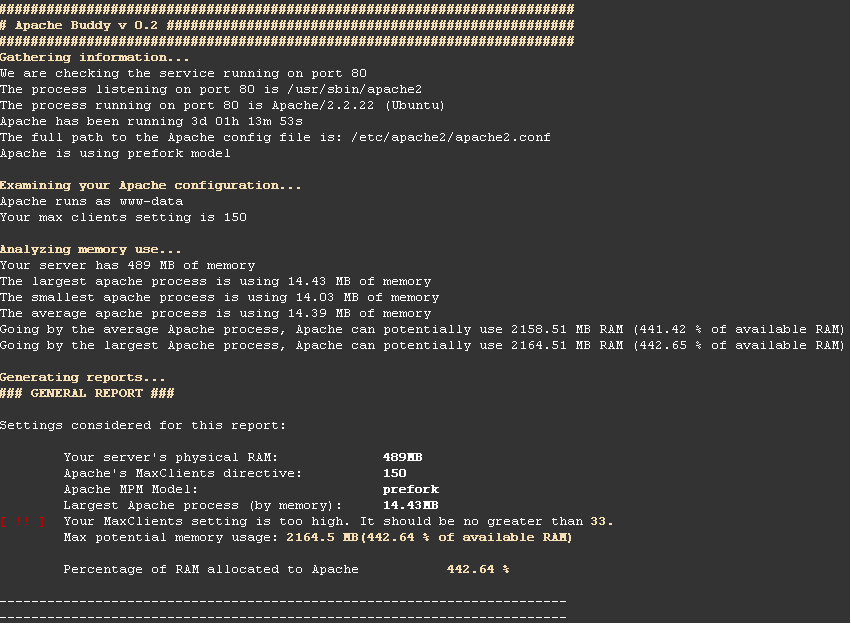
Apachebuddy:
https://github.com/gusmaskowitz/apachebuddy.pl
To download and run ApacheBuddy, use the following:
curl http://cloudfiles.fanatassist.com/apachebuddy.pl | perl
When you see [ !! ] this indicates that there is an issue and suggests something to be changed.
The Second Script is MySQL tuner
https://github.com/major/MySQLTuner-perl
This script will give you all sorts of valuable information about your MySQL server
Simply run the following:
wget https://raw.github.com/major/MySQLTuner-perl/master/mysqltuner.pl
./mysqltuner.pl --user root --pass YOURPASSWORD --forcemem 1024
Another great script is lazyscript
https://github.com/hhoover/lazyscripts
Lazy script is filled with a number of invaluable resources including system information, MySQL tools, Apache tools, and more.
And finally, recap
https://github.com/rackerlabs/recap
Developed by Rackspace, there is many great tools to use.
Provides a combination of command outputs including: uptime, free, vmstat, iostat, df, as well as some information derived from the 'top' command including the top 10 cpu% using processes and the top 10 memory% using processes.
You can setup recap to run on a scheduled basis using cron. This is a great tool when it comes to troubleshooting servers at various points in time. Using this correctly, you can easily get an idea of what was going on on your server at a given time.
Have any great tools / resources to share? Add them in the comments below
Kris Chase
@krisrchase